
Common Extruded Rubber Shapes and How to Choose Them
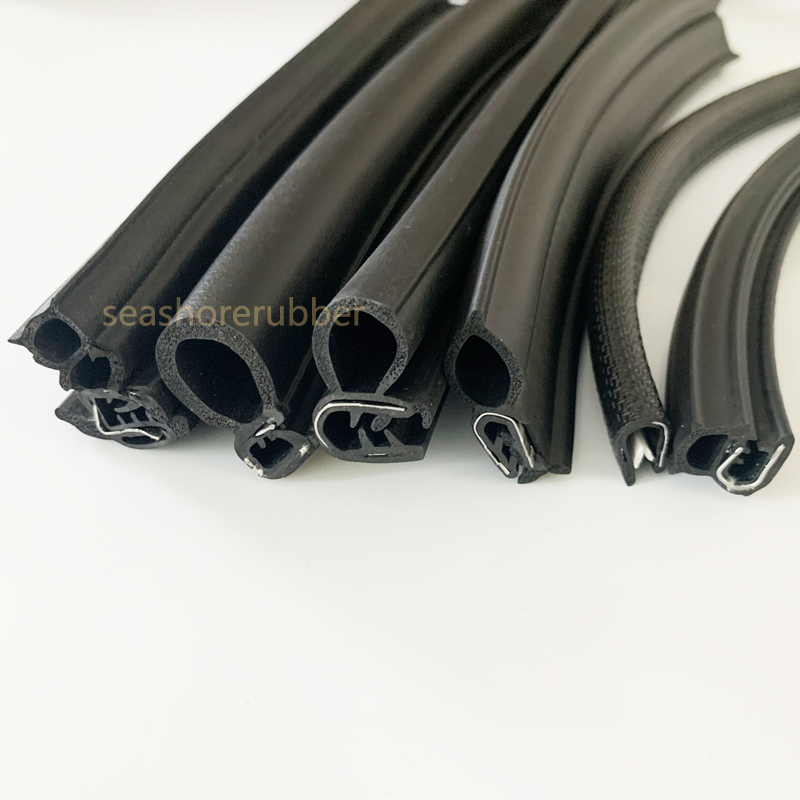
Extruded rubber shapes are continuous profiles manufactured by forcing uncured rubber compounds through specially designed dies. The profiles are then cured to stabilize their dimensions and develop the required physical properties.
Unlike molded rubber parts, which are produced as individual components, extrusions maintain the same cross-section along their length. This makes extrusion suitable for seals, channels, strips, cords, tubing and protective profiles used around doors, windows, panels, machinery and vehicle components.
However, profile selection should not be based on appearance alone. The cross-sectional shape, material, hardness, density and installation method must work together. A shape that performs well as an edge protector may not provide the compression recovery required for a long-term weather seal.
Common Types of Extruded Rubber Shapes
Extruded profiles range from simple solid strips to complex multi-cavity seals. Each shape controls how the rubber fits, compresses or moves in an assembly.
U-Shaped Rubber Channels
U-channels fit over sheet metal, glass, plastic panels or exposed edges. Their main functions include edge protection, cushioning, insulation and vibration reduction.
Some U-shaped profiles rely on the elasticity of the rubber to grip an edge. Others include internal ribs, lips or metal reinforcement to improve retention.
Typical applications include:
- Sheet metal edge protection
- Glass and panel mounting
- Machinery guards
- Vehicle body panels
- Electrical cabinet edges
The channel width should match the thickness of the mounting edge. If the channel is too narrow, installation becomes difficult and may stretch the profile. If it is too wide, the profile may loosen during service.
D-Shaped Rubber Profiles
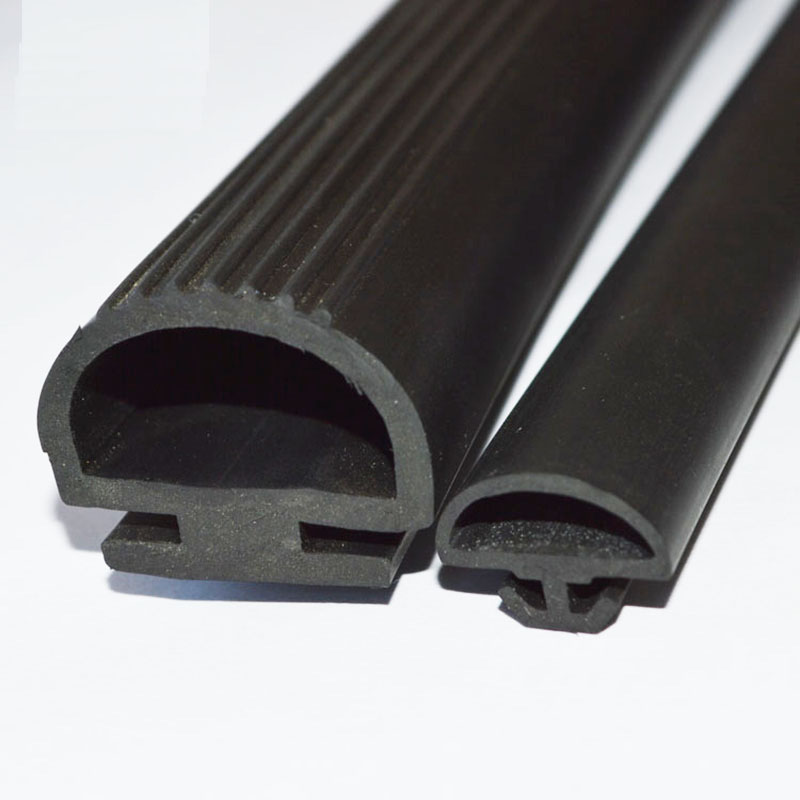
D-shaped profiles usually have a flat mounting base and a rounded or hollow sealing section. They are frequently used as compression seals around doors, hatches, enclosures and access panels.
A solid D-profile provides greater resistance to deformation, while a hollow D-profile compresses more easily. Hollow profiles are often more suitable when the available closing force is limited.
When selecting a D-shaped seal, buyers should consider the gap to be sealed, expected compression and the movement of the mating surfaces. Excessive compression can increase closing force and accelerate permanent deformation.
P-Shaped Rubber Seals
P-shaped profiles combine a rounded sealing bulb with a flat tail. The tail can be bonded, clamped or mechanically fastened to the assembly.
These profiles are used for:
- Vehicle doors and compartments
- Equipment cabinets
- Marine hatches
- Access covers
- Window and panel seals
The tail simplifies mounting, while the bulb creates a flexible barrier against air, dust, water or vibration. The direction of compression is important: the bulb should be loaded as intended instead of being dragged sideways whenever the door closes.
T-Shaped Rubber Profiles
T-profiles are commonly inserted into tracks, joints or specially designed grooves. The upper part may cover a gap, while the lower stem anchors the profile.
They can be used as joint fillers, floor seals, glazing components and protective strips. Successful installation depends on the relationship between the stem and the retaining groove. A loose stem may pull out, while excessive interference may make field installation impractical.
L-Shaped and Angle Profiles
L-shaped extrusions protect corners, cover joints or form flexible barriers between perpendicular surfaces. They may also be used as wiping lips or deflectors.
Their performance depends on the thickness and flexibility of each leg. A soft, thin leg can conform to uneven surfaces, whereas a thicker profile provides more impact protection but requires greater installation force.
Rubber Bulb Seals
Bulb seals use a hollow, rounded section that collapses under compression and recovers after the load is removed. The bulb may be combined with a flat base, clip-on carrier or channel section.
They are commonly installed on doors, lids, vehicle compartments and enclosures where the gap varies slightly along the sealing line. Bulb diameter alone does not determine suitability. Wall thickness, material hardness and compression set are equally important.
Lip and Wiper Profiles
Lip seals have one or more thin flexible extensions. Instead of being heavily compressed, the lip maintains light contact with a moving or stationary surface.
They are used to deflect water, dust and debris or to wipe a surface during movement. The contact angle and interference should be controlled carefully. Excessive interference can increase friction and wear, while insufficient contact can leave a leakage path.
Solid Cords, Squares and Rectangular Strips
Solid cords and simple strips are among the most versatile extruded rubber shapes. They can be used as packing, spacers, bumpers, gasket material or stock for secondary fabrication.
Cord can also be cut and vulcanized into rings. Rectangular strips may be supplied in continuous lengths or cut to specified dimensions.
These shapes are economical, but buyers should not assume that a solid section is always more durable. For compression sealing, a properly designed hollow profile may require less force and accommodate dimensional variation more effectively.
Solid, Sponge and Dual-Durometer Profiles
The internal structure of an extrusion changes how it responds to load.
| Profile construction | Main characteristic | Typical use |
|---|---|---|
| Solid rubber | Firm support and higher resistance to deformation | Edge protection, strips, channels and wear surfaces |
| Sponge rubber | Lower compression force and better conformity | Door seals, enclosure seals and weather stripping |
| Hollow profile | Controlled collapse under compression | Bulb seals and gap sealing |
| Dual-durometer profile | Combines rigid retention with a softer sealing area | Clip-on seals and complex mounting systems |
| Co-extruded profile | Combines materials or structures in one section | Multifunctional seals and reinforced profiles |
Solid rubber is normally selected where strength, abrasion resistance or structural support matters. Sponge rubber is useful when a soft seal must conform to uneven surfaces. Closed-cell sponge is generally preferred for sealing because its cell structure limits the passage of air and water more effectively than open-cell foam.
Dual-durometer profiles solve a common design conflict: the mounting section needs to remain firm, while the sealing section needs to compress easily. Producing both functions in one continuous profile can reduce assembly steps.
Choosing Materials for Extruded Rubber Shapes
Shape determines how a profile seals, but the compound determines whether it survives the operating environment.
EPDM is widely used for outdoor seals because of its resistance to weathering, ozone and water. It is commonly selected for doors, windows, enclosures and vehicle weather seals. However, it is generally unsuitable for continuous contact with petroleum oils.
NBR, or nitrile rubber, is commonly used around oils, fuels and petroleum-based hydraulic fluids. It is suitable for machinery, automotive and fluid-handling applications, but usually offers less outdoor weather resistance than EPDM.
Neoprene provides a balance of weather, moderate oil and mechanical resistance. It is frequently selected for equipment seals, cable protection and outdoor components that may experience mixed exposure.
Silicone remains flexible across a broad temperature range and is used for ovens, lighting, electrical equipment and applications requiring clean or colored profiles. Its tear and abrasion performance must still be evaluated for the specific design.
Material names alone are not complete specifications. Different formulations of the same elastomer can have different hardness, compression set, tensile strength, flame resistance and chemical compatibility.
How to Select the Right Extruded Shape
Begin with the function of the profile rather than selecting a familiar cross-section.
For compression seals, define the minimum and maximum operating gap. The profile must maintain contact at the largest gap without becoming over-compressed at the smallest gap.
For edge protection, define the edge thickness, bend radius and required grip. For wiping profiles, specify the direction of movement, contact pressure and exposure to abrasive contamination.
The specification should also cover:
- Service temperature
- Contact with oils, fuels, cleaners or chemicals
- Outdoor and ozone exposure
- Required hardness or compression behavior
- Solid or sponge construction
- Installation method
- Length, cutting and joining requirements
- Color and surface finish
- Applicable testing or regulatory requirements
A profile drawing should include a complete cross-section with dimensions and tolerances. The assembly drawing is also valuable because it shows the mounting position, compression direction and nearby components.
Conclusion
Extruded rubber shapes are functional elements rather than simple geometric products. U-channels protect edges, D- and P-profiles provide compression sealing, T-profiles fit into retaining grooves, and lip profiles create wiping contact. Solid, sponge, hollow and dual-durometer constructions further change how each shape behaves.
The most reliable selection process connects the profile geometry to the operating gap, mounting method, environmental exposure and required compression. When standard profiles cannot meet those conditions, a custom extrusion can integrate the necessary sealing and installation features into one continuous component.


Leave a Reply
Want to join the discussion?Feel free to contribute!