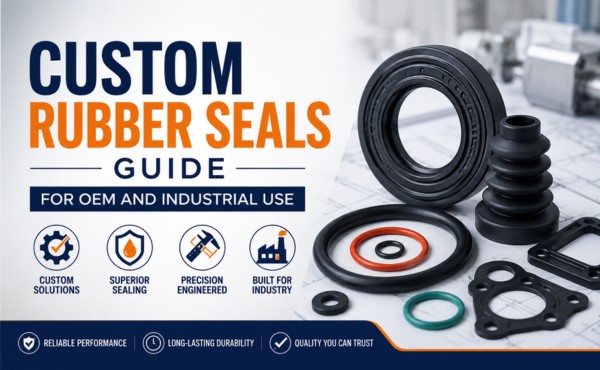
Custom Rubber Seals Guide for OEM and Industrial Use
When equipment fails in the field, the culprit is often something surprisingly small — a degraded seal, a mismatched gasket, or a rubber component that was never designed for the actual operating environment. Custom rubber seals are the unsung workhorses of modern manufacturing, keeping hydraulic systems pressurized, food processing lines contamination-free, and aerospace components performing under extreme conditions. For OEMs and industrial manufacturers, the difference between a standard off-the-shelf seal and a precision-engineered custom solution can mean the difference between a product that lasts decades and one that fails in months.
This guide covers everything engineers, procurement teams, and OEM designers need to know about custom rubber seals — from material selection and manufacturing processes to supplier partnerships and emerging technologies.
What Are Custom Rubber Seals?
Definition of Custom Rubber Seals
Custom rubber seals are elastomeric components manufactured to specific dimensions, tolerances, material compositions, and performance requirements that standard catalog seals cannot meet. Unlike off-the-shelf options that require engineers to design around available sizes, custom seals are engineered around the application — matching exact bore dimensions, shaft tolerances, chemical exposures, and pressure ratings.
Their primary function is to prevent fluid or gas leakage, block contamination ingress, and maintain pressure integrity across mechanical interfaces. Whether static (no relative motion between mating surfaces) or dynamic (sealing around rotating or reciprocating components), custom seals deliver a level of reliability that generalized solutions simply cannot match.
Common Industries Using Custom Rubber Seals
Custom rubber seals serve virtually every industrial sector. The automotive industry relies on them for engine gaskets, transmission seals, fuel system components, and brake systems. Aerospace applications demand seals that perform across extreme temperature ranges and resist aviation fluids. Oil and gas operations require seals capable of handling aggressive hydrocarbons, high pressures, and corrosive environments deep underground or offshore.
Food processing equipment uses FDA-compliant silicone and EPDM seals to prevent contamination across wash-down cycles. Medical device manufacturers depend on biocompatible elastomers that meet strict regulatory standards. Heavy machinery, HVAC systems, electronics enclosures, and marine equipment round out the extensive list of industries where custom sealing solutions are critical to operational success.
Key Benefits of Custom Rubber Seals
The advantages of going custom over standard extend well beyond dimensional fit. Precision-engineered seals reduce friction in dynamic applications, extend equipment service intervals, and lower total lifecycle costs. When a seal is designed specifically for the operating chemistry and temperature range of a system, premature failures caused by swelling, cracking, or compression set become far less common. For OEMs, that translates directly into fewer warranty claims, stronger brand reputation, and more competitive product designs.
Types of Custom Rubber Seals
O-Rings
O-rings are the most widely used sealing element in industrial and commercial applications. These toroidal rings seat into a machined groove and compress between mating surfaces to create a leak-proof barrier. They work in both static and dynamic configurations and are manufactured from nearly every elastomer compound available — NBR for oil resistance, silicone for high-temperature food contact, Viton for aggressive chemical environments. Custom O-rings are specified when standard AS568 or metric sizes don’t match groove geometry or when a specialized compound is required.
Rubber Gaskets
Gaskets provide static sealing between two flat or semi-flat mating surfaces — flanges, pipe connections, valve bodies, and covers. Custom rubber gaskets are cut or molded to match exact bolt patterns, port configurations, and surface geometries. Sheet gasket materials include EPDM, neoprene, silicone, and compressed non-asbestos fiber composites, selected based on the fluid being sealed, operating pressure, and temperature.
Extruded Rubber Seals
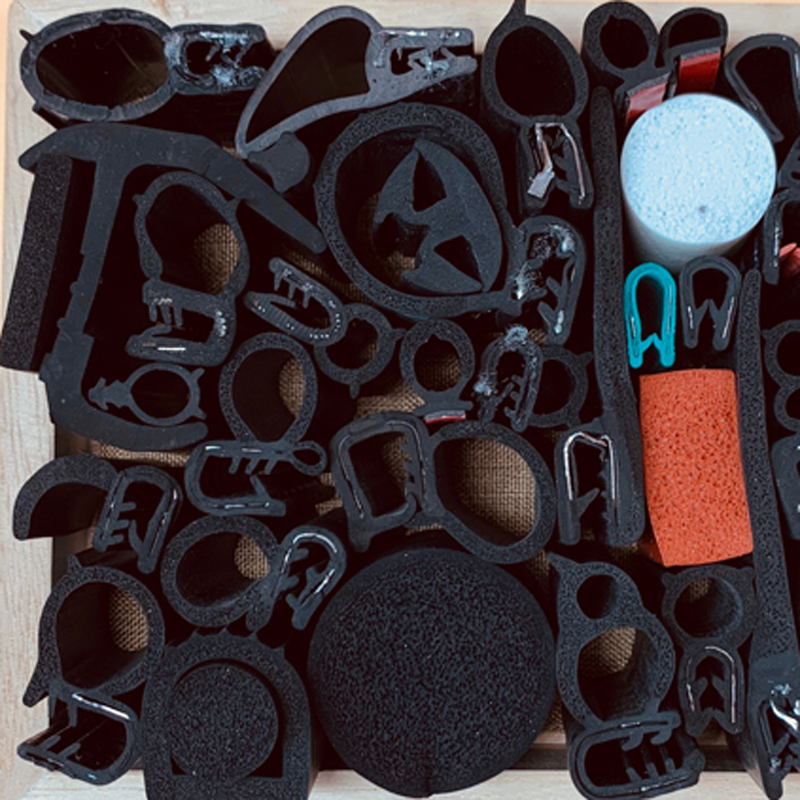
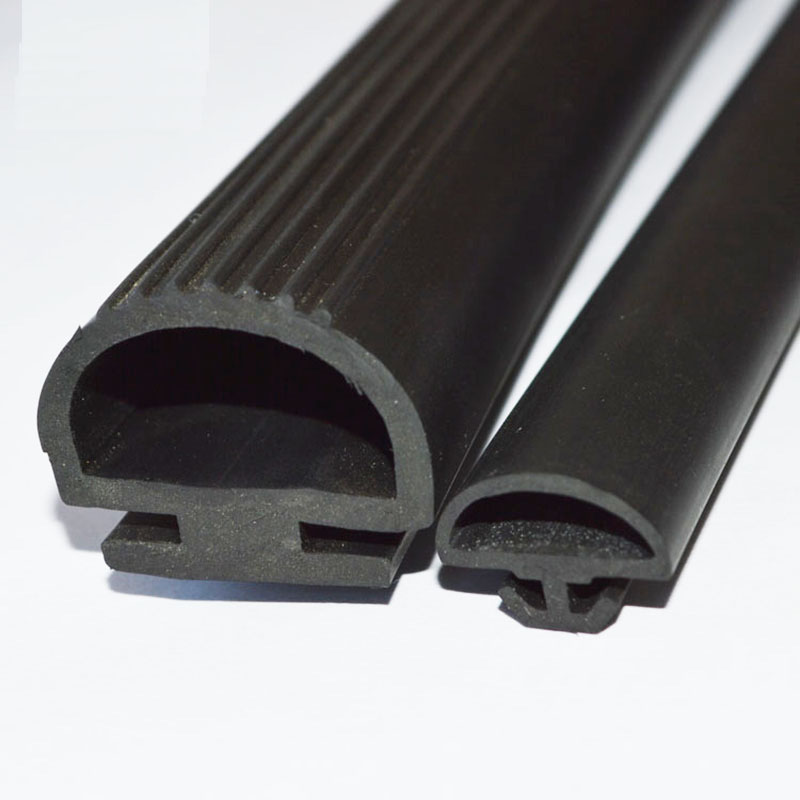
Extrusion produces continuous profiles — D-sections, P-sections, bulb seals, and complex custom shapes — used extensively in door and window sealing, industrial enclosures, automotive body sealing, and access panels. The process allows for highly consistent cross-sections across long lengths, making it ideal for perimeter sealing applications where the seal profile needs to compress uniformly along its entire run.
Lip Seals
Lip seals, also called radial shaft seals, feature a flexible sealing lip that maintains contact with a rotating shaft to retain lubricants and exclude contaminants. Custom lip seals are designed to match specific shaft diameters, housing bores, and rotational speeds. They’re standard components in gearboxes, pumps, electric motors, and hydraulic cylinders.
U-Cups and Hydraulic Seals
U-cup seals are single-acting seals designed for hydraulic and pneumatic cylinders operating under high pressure. Their U-shaped cross-section energizes the sealing lips against the cylinder bore and rod, providing effective sealing in both directions when used in pairs. Custom hydraulic seals are engineered to handle system pressures often exceeding 3,000 PSI while maintaining low friction coefficients to protect cylinder efficiency.
Custom Molded Rubber Parts
Beyond standard seal geometries, OEMs frequently require complex molded rubber components — multi-durometer boots, integrated sealing assemblies, rubber-to-metal bonded parts, and custom profiles that combine sealing, vibration damping, and structural functions in a single component. Injection and compression molding make these geometrically complex parts possible with tight tolerances.
Best Materials for Custom Rubber Seals
Material selection is arguably the most consequential decision in custom seal design. The wrong compound can cause seal failure within weeks; the right one can deliver decades of reliable service.
EPDM (Ethylene Propylene Diene Monomer) excels in outdoor and weather-exposed applications. Its outstanding resistance to UV radiation, ozone, steam, and weathering makes it the standard choice for automotive door seals, roofing membranes, and HVAC gaskets. EPDM is not compatible with petroleum-based oils or fuels, making application compatibility critical.
Silicone rubber handles temperature extremes better than virtually any other elastomer, performing reliably from -60°C to over 200°C. Its biocompatibility and availability in FDA-compliant grades make it the material of choice for food processing equipment, pharmaceutical applications, and medical devices. Silicone’s lower tensile strength makes it less suitable for high-pressure dynamic sealing.
Nitrile rubber (NBR) offers excellent resistance to petroleum oils, fuels, and hydraulic fluids at a cost-effective price point. It’s the dominant material in automotive sealing, industrial hydraulics, and fuel handling systems. Standard NBR is limited to temperatures below approximately 120°C; hydrogenated nitrile (HNBR) extends both temperature and chemical resistance for more demanding applications.
Viton® / FKM is the premium choice when chemical resistance and high-temperature performance are both required. It maintains integrity against fuels, lubricants, hydraulic fluids, and a broad range of aggressive chemicals at temperatures up to 200°C continuously. Its higher cost is justified in critical applications where failure is not an option.
Neoprene (CR) provides a balanced profile — moderate oil resistance, good weather and ozone resistance, and solid mechanical properties. It’s widely used in marine applications, refrigeration equipment, and general industrial sealing where a versatile, mid-range performer is needed.
Natural rubber delivers superior flexibility and abrasion resistance, making it valuable in applications involving dynamic movement, impact loading, or wear. Mining equipment, conveyor systems, and vibration isolation mounts frequently specify natural rubber compounds.
How to Choose the Right Custom Rubber Seal
Match Material to Operating Conditions
Begin with a systematic analysis of the operating environment. Document the minimum and maximum temperatures the seal will experience — both during operation and storage. Identify every fluid or chemical the seal will contact, including cleaning agents and secondary process fluids. Specify the system pressure range and whether the application is static or involves shaft rotation, reciprocation, or oscillation.
Environmental Exposure
Seals in outdoor or exposed equipment must withstand UV radiation, ozone attack, moisture cycling, and temperature extremes. Interior industrial seals may face chemical splash, cleaning agents, or abrasive particles. Each exposure condition narrows the appropriate material selection.
Compression Set Resistance
Compression set measures a seal’s ability to recover its original dimensions after being compressed over time. Seals with high compression set lose their sealing force and eventually leak. Applications with elevated temperatures or long service intervals demand materials with inherently low compression set — silicone and FKM generally outperform NBR and neoprene in this regard.
Industry Certifications
Regulated industries impose material certification requirements that must be confirmed before specifying a compound. Food contact applications typically require FDA 21 CFR 177.2600 compliance. Drinking water systems may require NSF/ANSI 61 certification. European market products often require REACH and RoHS compliance. Medical applications may require USP Class VI or ISO 10993 biocompatibility testing.
OEM Design Considerations for Rubber Seals
Successful custom seal design begins with clear communication between the OEM engineering team and the seal manufacturer. Provide detailed dimensional drawings with tolerances specified for all critical dimensions — groove width, depth, bore diameter, and surface finish requirements. CAD files in standard formats (STEP, IGES, DXF) accelerate the quoting and tooling process significantly.
Durometer hardness directly affects sealing behavior. Softer compounds (40–50 Shore A) conform more readily to surface irregularities but have lower extrusion resistance under pressure. Harder compounds (70–90 Shore A) handle higher pressures but require smoother mating surfaces. Most hydraulic and pneumatic seals fall in the 70–80 Shore A range.
Prototype testing before committing to production tooling is strongly recommended for critical applications. Functional prototypes, produced via CNC cutting or rapid tooling, validate dimensional fit, compression behavior, and material compatibility before significant tooling investment is made.
Manufacturing Processes for Custom Rubber Seals
Compression molding is the most common process for custom rubber seals — preformed rubber blanks are placed in a heated mold cavity, and pressure causes the material to flow and cure in the mold shape. It’s cost-effective for medium volumes and handles most seal geometries competently.
Injection molding offers tighter dimensional tolerances and faster cycle times for high-volume production. Liquid rubber is injected under pressure into a closed mold, reducing flash and material waste. It’s the preferred process for complex geometries requiring consistent quality across large quantities.
Transfer molding sits between compression and injection — rubber is placed in a pot and transferred through sprues into the mold cavities under pressure. It provides better dimensional consistency than compression molding while remaining cost-effective for moderate complexities.
Extrusion continuously forces rubber compound through a shaped die to produce profiles of consistent cross-section. Cut to length and vulcanized, extruded seals serve perimeter, edge, and linear sealing applications efficiently.
CNC and die cutting produce flat gaskets and seals from sheet stock without tooling investment — ideal for prototypes, small production runs, or applications requiring quick turnaround.
Common Problems and Troubleshooting
Seal failures nearly always trace back to one of a handful of root causes.
Leakage most commonly results from improper groove dimensions, inadequate compression load, surface finish deficiencies on mating hardware, or seal damage during installation.
Compression set failure occurs when material loses elasticity over time, typically accelerated by elevated temperatures or incompatible chemical exposure.
Chemical swelling happens when the elastomer absorbs a fluid it’s not compatible with, growing in volume and losing mechanical properties.
Cracking and hardening indicate ozone attack, UV degradation, or thermal aging beyond the material’s temperature rating. In each case, the solution begins with accurately characterizing the operating conditions and confirming material compatibility.
How to Work with a Rubber Seal Manufacturer
Effective OEM-supplier collaboration requires complete information sharing from the start. Provide dimensional drawings with tolerances, CAD files, operating temperature and pressure data, a complete list of chemical exposures, required certifications, expected production volumes, and target lead times. The more completely the operating environment is documented, the more accurately the manufacturer can recommend the right material and geometry.
Key questions to ask prospective suppliers include: What elastomer compounds do you compound in-house versus purchase? What testing capabilities do you have for material validation? What are your standard and expedite lead times? What quality management certifications do you hold (ISO 9001, IATF 16949, AS9100)? What are your minimum order quantities for tooled versus cut seals?
FAQ
What is the best material for industrial rubber seals?
There is no single best material — the optimal compound depends entirely on the application. NBR suits oil and fuel environments; silicone handles temperature extremes and food contact; Viton/FKM provides the best combination of chemical and heat resistance for demanding industrial applications.
How long do custom rubber seals last?
Service life varies widely by material, application conditions, and maintenance practices. Well-specified seals in appropriate environments typically last from 5 to 15 years or longer. Improper material selection or exposure to incompatible chemicals can reduce service life to months.
Can rubber seals withstand chemicals and high temperatures?
Yes, with correct material selection. Viton/FKM seals handle temperatures up to 200°C and resist a broad chemical spectrum. Silicone performs at even higher temperatures in dry heat. Always verify compatibility through chemical resistance charts and, for critical applications, immersion testing.
What is the difference between O-rings and gaskets?
O-rings are circular cross-section rings that seat in machined grooves and seal by compression. Gaskets are flat components that seal between two mating faces, typically bolted together. O-rings suit both static and dynamic applications; gaskets are primarily static sealing solutions.
How are custom rubber seals manufactured?
Depending on geometry and volume, through compression molding, injection molding, transfer molding, extrusion, or CNC/die cutting from sheet stock.
Conclusion
Selecting the right custom rubber seal is a systems engineering decision — one that requires careful analysis of operating conditions, material chemistry, dimensional requirements, and long-term reliability expectations. The upfront investment in a properly engineered custom sealing solution consistently delivers returns through reduced downtime, lower maintenance costs, longer equipment life, and fewer warranty claims.
For OEMs and industrial manufacturers, partnering with an experienced rubber seal manufacturer who brings material science expertise, quality management discipline, and responsive engineering support is as important as the seal specification itself. Get the seal right from the beginning, and it becomes one of the least-noticed — and most valuable — components in your entire product.


Leave a Reply
Want to join the discussion?Feel free to contribute!