
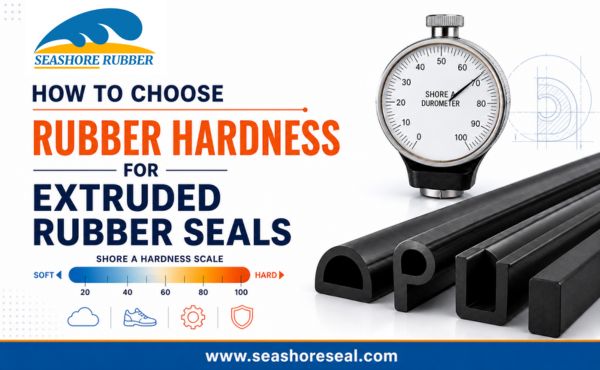
How to Choose Rubber Hardness for Extruded Rubber Seals
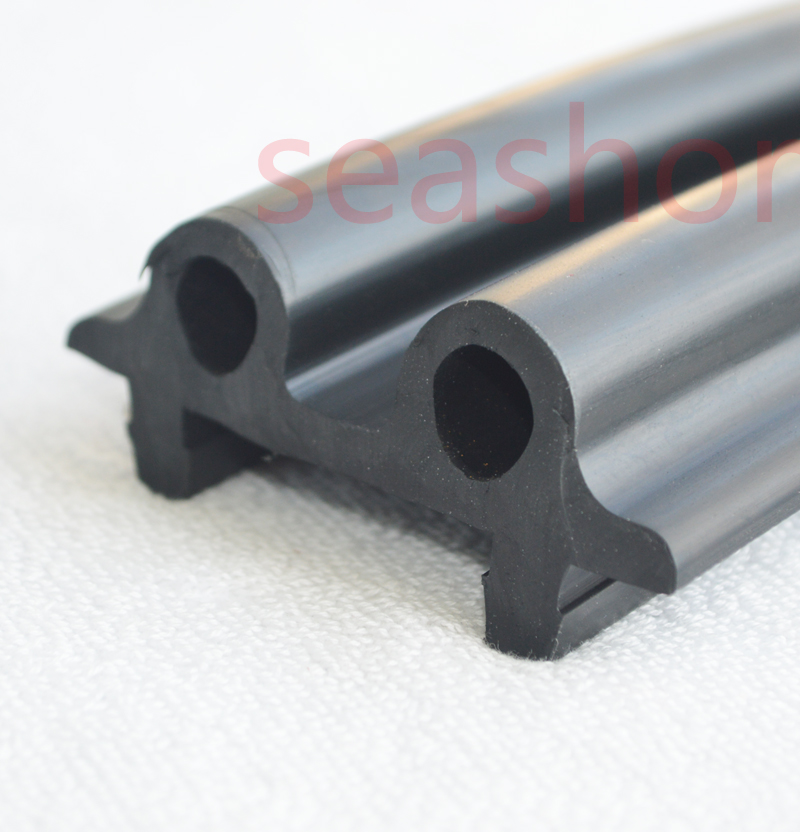
Choosing the correct rubber hardness is essential to the performance of extruded rubber seals. If the material is too soft, the seal may deform excessively, wear quickly, or fail to remain securely in place. If it is too hard, it may not compress enough to fill gaps or irregular surfaces.
For most extruded rubber seals, hardness is measured using the Shore A scale. The appropriate value depends on the seal design, compression requirements, operating environment, material type, and expected mechanical stress. Understanding these factors helps manufacturers and buyers select a seal that balances flexibility, durability, and long-term sealing performance.
Why Rubber Hardness Matters for Extruded Seals
Rubber hardness describes how resistant a material is to indentation. It affects how easily an extruded profile bends, compresses, stretches, and returns to its original shape.
Hardness does not indicate overall rubber quality. A harder rubber is not automatically better than a softer one. The correct hardness is the value that matches the application and profile design.
Flexibility and Sealing Performance
Soft rubber conforms more easily to uneven surfaces. It can fill small gaps, accommodate installation tolerances, and create contact across irregular mating surfaces.
This makes softer compounds suitable for applications such as:
- Door and window seals
- Glazing profiles
- Weatherstripping
- Cabinet seals
- Low-pressure enclosures
However, very soft rubber may not provide enough structural support for demanding installations.
Harder rubber offers greater resistance to deformation. It is often selected when the seal must maintain its profile under pressure, mechanical loading, or repeated movement.
Compression and Surface Contact
An effective compression seal must generate enough contact pressure to block water, dust, air, noise, or other contaminants.
Soft rubber requires less force to compress, making it useful for lightweight doors, thin panels, and applications with limited closing pressure. Harder rubber requires greater compression force but can provide a firmer sealing surface.
The ideal hardness should allow the seal to compress within the designed range without becoming permanently flattened.
Durability and Wear Resistance
Harder rubber generally performs better under abrasion, friction, and mechanical impact. It may also resist cutting, tearing, and extrusion under pressure more effectively.
Softer rubber is usually more flexible but may wear faster when exposed to sliding contact or rough surfaces. Therefore, applications involving frequent movement often require a balance between flexibility and abrasion resistance.
Understanding Rubber Hardness and Durometer Scales
Rubber hardness is commonly measured with a durometer. The device presses an indenter into the rubber surface and displays a numerical hardness value.
Higher readings indicate harder rubber, while lower readings indicate softer rubber.
What Is Rubber Durometer?
Durometer can refer to both the testing instrument and the hardness measurement itself. A typical reading may be expressed as 60 Shore A, 70 Shore A, or another value depending on the selected scale.
The test should be performed on a suitable sample thickness and under controlled conditions. Thin or curved extruded profiles can produce inconsistent readings, so manufacturers may test a standard molded sample made from the same compound.
Shore A vs. Shore D
Shore A is the most widely used scale for flexible rubber materials. It covers soft sealing compounds through relatively firm rubber products.
Shore D is intended for harder materials, including rigid rubber, plastics, and thermoplastic products. Most conventional EPDM, silicone, neoprene, and NBR extruded seals are specified in Shore A rather than Shore D.
For general rubber sealing products, Shore A is usually the most relevant scale.
IRHD Testing
IRHD stands for International Rubber Hardness Degrees. It is another method used to evaluate rubber hardness.
IRHD testing is often used in technical laboratories and for smaller rubber components. Although IRHD and Shore A values may appear similar within certain ranges, they are not always directly interchangeable.
Buyers should confirm which testing method is stated on drawings, specifications, and quality documents.
Common Shore A Hardness Ranges for Extruded Seals
Extruded rubber seals are available in many hardness levels. However, several ranges are commonly used across automotive, construction, glazing, industrial, and equipment applications.
| Hardness Range | General Characteristics | Typical Applications |
|---|---|---|
| 30–40 Shore A | Very soft and highly flexible | Delicate sealing, low closing force, irregular surfaces |
| 50–60 Shore A | Flexible with moderate strength | Weatherstripping, doors, windows, general sealing |
| 65–70 Shore A | Firm and durable | Industrial seals, machinery profiles, automotive components |
| 75–80 Shore A | Hard and wear resistant | Guide strips, protective profiles, high-load applications |
These ranges provide general guidance only. The final selection should consider the complete profile structure and operating conditions.
30–40 Shore A: Soft and Flexible Seals
Rubber in this range compresses easily and conforms well to uneven surfaces. It can provide effective sealing where only limited force is available.
Typical applications include lightweight enclosure seals, soft glazing strips, flexible silicone profiles, and seals for delicate surfaces.
The main disadvantages are lower structural stability and reduced resistance to abrasion or mechanical loading.
50–60 Shore A: General-Purpose Seals
This is one of the most widely used hardness ranges for extruded rubber seals. It offers a practical balance between flexibility, compression, recovery, and durability.
Profiles in this range are commonly used for:
- Automotive weatherstripping
- EPDM door and window seals
- Construction joints
- Industrial enclosure seals
- Glazing profiles
- Equipment covers
A hardness of approximately 60 Shore A is often suitable for general-purpose sealing, but it should not be treated as a universal standard.
65–70 Shore A: Firm and Durable Seals
Rubber in this range provides improved resistance to deformation, abrasion, and mechanical stress. It is useful when the extrusion must maintain its shape under pressure or repeated movement.
Typical applications include machinery seals, industrial edge protection, automotive profiles, equipment components, and firmer retaining strips.
More closing or installation force may be required compared with softer grades.
75–80 Shore A: Hard and Wear-Resistant Profiles
These materials are relatively firm and may feel closer to flexible plastic than soft rubber.
They are suitable for guide rails, support strips, heavy-duty bumpers, protective profiles, and components exposed to substantial friction or load. However, they may not conform well to wide tolerances or irregular surfaces.
Key Factors When Choosing Rubber Hardness
Selecting hardness based only on a standard value can lead to poor sealing performance. The complete application must be evaluated.
Application and Sealing Pressure
Determine what the seal must block and how much pressure it will experience.
Low-pressure dust and air seals may use softer compounds. Water-resistant or mechanically loaded seals may require greater firmness and stability.
For higher-pressure applications, hardness must be considered together with profile geometry, contact area, groove design, and reinforcement.
Compression and Gap Size
The available gap and expected compression directly influence hardness selection.
A softer rubber is often more forgiving when gap dimensions vary. A harder rubber may work well when the installation dimensions are controlled precisely.
The seal should not be compressed excessively. Over-compression can increase closing force, accelerate compression set, and reduce service life.
The ideal compression percentage depends on the rubber material and profile shape. Sponge rubber and solid rubber also behave differently and should not be evaluated using the same assumptions.
Surface Shape and Fit
Flat, smooth surfaces are easier to seal than rough, curved, or uneven surfaces.
Softer rubber can adapt to irregular contact areas, while harder rubber may leave small leakage paths if the surface is not uniform.
Profile design is equally important. Hollow bulb seals, lip seals, D-shaped profiles, U-channels, and solid strips distribute force in different ways. A hollow profile made from firmer rubber may compress more easily than a solid profile made from a softer compound.
Temperature and Weather Exposure
Operating temperature can change rubber hardness.
Cold conditions generally make rubber firmer and less flexible. High temperatures may soften the material temporarily and accelerate aging over time.
Outdoor seals must also withstand ozone, UV exposure, rain, and changing weather conditions. EPDM is commonly selected for outdoor applications because of its weather resistance, while silicone remains flexible across a wide temperature range.
The hardness value should be evaluated under actual service conditions rather than only at room temperature.
Chemical and Oil Exposure
Chemical exposure affects both material selection and long-term hardness.
For example, NBR is frequently used where resistance to oil and fuel is required. EPDM is generally suitable for water, steam, weather, and many diluted chemicals, but it is not normally recommended for petroleum oils.
If an incompatible rubber is exposed to a chemical, it may swell, harden, soften, crack, or lose strength. Selecting the correct hardness cannot compensate for choosing the wrong rubber material.
Abrasion and Mechanical Wear
Seals exposed to sliding contact, repeated movement, vibration, or rough surfaces need sufficient wear resistance.
A harder grade may improve abrasion resistance, but excessive hardness can reduce flexibility and sealing contact. In these cases, manufacturers may adjust the rubber formulation to improve tear strength and wear resistance without increasing hardness too much.
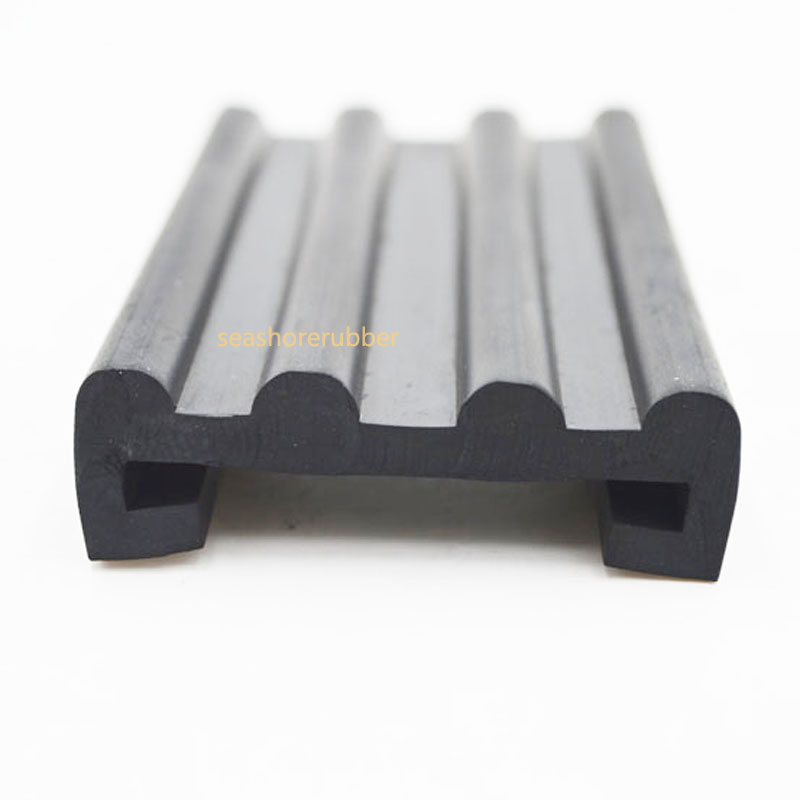
Recommended Hardness for Different Seal Applications
There is no single hardness suitable for every industry. The following ranges are common starting points.
Door and Window Seals
EPDM door and window seals are frequently produced between 50 and 70 Shore A.
Softer grades are suitable for easy compression and uneven gaps. Firmer grades may be selected for retaining profiles, frame inserts, or sections that need greater dimensional stability.
Automotive Rubber Seals
Automotive weatherstripping often combines different materials or hardness levels within one profile.
A dense rubber section may provide secure mounting, while a softer sponge section creates the sealing surface. This co-extruded design balances installation strength with low compression force.
Solid automotive rubber profiles are commonly found around 60–70 Shore A, although the exact requirement varies significantly by component.
Industrial Equipment Seals
Industrial enclosure and machinery seals often use hardness values between 55 and 75 Shore A.
Applications involving vibration, frequent opening, abrasion, or mechanical pressure may require firmer compounds. Sensitive panels or low-force access doors may perform better with softer materials.
Glazing and Construction Seals
Glazing gaskets must hold glass securely while absorbing movement and avoiding excessive stress.
Many solid EPDM glazing profiles use medium hardness ranges, often around 60–70 Shore A. The selected value must support the glass, maintain weather resistance, and permit practical installation.
High-Wear Applications
Protective strips, guide profiles, and seals exposed to friction may require 70 Shore A or above.
However, harder materials should only be used when the profile can still maintain sufficient contact with the mating surface.
How Rubber Material Affects Hardness Selection
Different rubber materials with the same Shore A reading may not perform identically.
EPDM Rubber
EPDM provides excellent resistance to weather, ozone, UV radiation, and moisture. It is widely used for outdoor sealing, construction, glazing, and automotive weatherstripping.
Typical hardness values range from approximately 40 to 80 Shore A.
Silicone Rubber
Silicone remains flexible at both high and low temperatures. It is suitable for food equipment, lighting, electronics, ovens, and temperature-sensitive applications.
Silicone may feel softer and more elastic than some other materials at the same nominal hardness.
Neoprene Rubber
Neoprene offers balanced resistance to weathering, moderate oils, flame, and mechanical stress. It is used in industrial, marine, construction, and equipment applications.
Common extruded grades are available across medium hardness ranges.
NBR Rubber
NBR is mainly selected for oil, grease, and fuel resistance. It is frequently used in machinery, engines, hydraulic equipment, and industrial systems.
NBR extrusions may use medium to firm hardness levels depending on pressure and wear requirements.
How to Test and Confirm the Right Hardness
Technical data can help narrow the selection, but physical testing is the most reliable way to confirm performance.
Begin by reviewing the gap size, compression force, temperature, chemical exposure, movement, and expected service life. Select an initial hardness range based on these conditions.
Next, request extrusion samples made with the intended material and profile dimensions. Test the samples in the actual groove, frame, panel, or assembly.
Evaluate:
- Installation difficulty
- Closing or clamping force
- Contact across the full sealing surface
- Recovery after compression
- Leakage resistance
- Movement under load
- Wear after repeated operation
For custom extruded rubber seals, prototype testing should be completed before bulk production. Even a small change in wall thickness, hollow chamber size, or lip angle can affect compression more than a minor change in Shore A hardness.
Frequently Asked Questions
What is the most common hardness for rubber seals?
Many general-purpose solid rubber seals use approximately 60–70 Shore A. However, softer or harder grades may be required depending on compression force, profile design, and operating conditions.
Is 60 Shore A hard or soft?
A hardness of 60 Shore A is considered medium hardness for rubber. It provides a useful balance of flexibility, strength, and durability for many sealing applications.
Does harder rubber provide better sealing?
Not necessarily. Harder rubber offers greater resistance to deformation, but it may not conform well to irregular surfaces. Effective sealing depends on achieving the right contact pressure and compression.
Can rubber hardness change over time?
Yes. Heat, cold, ozone, UV exposure, chemicals, and aging can cause rubber to harden or soften. A compatible compound should be selected for the intended environment.
How much hardness tolerance is acceptable?
Manufacturers commonly specify a hardness tolerance around the target value, such as 60 ±5 Shore A. The acceptable tolerance depends on the application, material formulation, and quality requirements.
Conclusion
Choosing rubber hardness for extruded rubber seals requires more than selecting a standard Shore A value. Buyers should consider compression, surface fit, operating temperature, chemical exposure, wear, profile geometry, and rubber material.
Soft compounds provide easier compression and better conformity, while harder compounds offer improved stability and wear resistance. For many general sealing applications, 50–70 Shore A provides a useful starting range. However, sample testing under actual operating conditions remains the best way to confirm the final material and hardness before bulk production.


Leave a Reply
Want to join the discussion?Feel free to contribute!