Types of Waterstops for Concrete Joints: Uses and Differences

Waterstops are sealing components installed at concrete joints to prevent water from passing through gaps between adjacent concrete sections. They are widely used in basements, tunnels, dams, reservoirs, water treatment plants, and other water-retaining or underground structures.
The main types of waterstops include PVC waterstops, rubber waterstops, hydrophilic waterstops, and metal waterstops. They differ in material properties, sealing mechanisms, joint movement capacity, and installation requirements.
PVC and rubber waterstops form physical barriers within concrete joints, while hydrophilic waterstops expand when exposed to water to create a compressed seal. Selecting the correct type depends primarily on joint movement, water pressure, chemical exposure, and installation conditions.
Main Types of Waterstops for Concrete Joints
Waterstops can be classified according to their materials and sealing mechanisms. Although several types can provide effective waterproofing, they are not interchangeable in every application.
| Waterstop Type | Main Characteristics | Typical Applications |
|---|---|---|
| PVC Waterstop | Flexible thermoplastic barrier available in multiple profiles | Construction joints, expansion joints, basements, water tanks |
| Rubber Waterstop | Elastic barrier manufactured from natural or synthetic rubber | Movement joints, tunnels, dams, bridges |
| Hydrophilic Waterstop | Swelling strip that expands upon water contact | Non-moving construction joints, wall-to-slab connections, pipe penetrations |
| Metal Waterstop | Rigid or formed metallic barrier | Selected construction joints, containment structures, and specialized concrete works |
The appropriate profile and material should be selected according to the actual conditions of the joint.
PVC Waterstops
PVC waterstops are manufactured from flexible polyvinyl chloride compounds. They are installed across or along concrete joints to create a continuous barrier against water penetration.
PVC waterstops are commonly embedded during concrete placement. One portion is anchored in the first concrete section, while the remaining portion becomes embedded in the adjacent section.
Their main advantages include flexibility, availability in different cross-sectional designs, and the ability to form continuous joints through heat welding.
Common PVC waterstop profiles include flat ribbed, dumbbell, centerbulb, and external base-seal designs.
PVC waterstops are widely used in:
- Basement walls and foundations
- Water storage tanks
- Swimming pools
- Sewage and wastewater treatment plants
- Underground concrete structures
- Construction and movement joints
PVC waterstops are often economical for general concrete waterproofing projects. However, chemical compatibility, temperature conditions, hydrostatic pressure, and expected movement must be confirmed before selection.
The profile geometry is particularly important. A flat PVC waterstop intended for a non-moving construction joint should not automatically replace a centerbulb profile designed to accommodate joint movement.
Rubber Waterstops
Rubber waterstops are manufactured from natural rubber or synthetic elastomer compounds and are designed to maintain a waterproof barrier between adjoining concrete sections.
Their elasticity makes them suitable for applications where flexibility and the ability to accommodate movement are important.
Common materials may include natural rubber, EPDM, neoprene, or other application-specific compounds.
However, the properties of rubber waterstops vary according to their formulations. The rubber material alone does not determine allowable movement, water pressure resistance, or service life.
Rubber waterstops are frequently specified for:
- Dams and reservoirs
- Bridge and highway structures
- Underground tunnels
- Water-retaining concrete structures
- Expansion and contraction joints
Different rubber profiles can be manufactured to suit the required joint geometry.
For movement joints, centerbulb and other flexible configurations can accommodate changes in joint width and relative displacement when appropriately designed.
Rubber waterstops must also be joined using methods compatible with the selected elastomer. Unlike conventional flexible PVC waterstops, vulcanized rubber products generally cannot be joined using standard PVC heat-welding procedures.
For demanding applications, rubber hardness, tensile strength, elongation, aging resistance, and movement capacity should be verified against the project specification.
Hydrophilic Waterstops
Hydrophilic waterstops seal concrete joints through controlled swelling when exposed to water.
These products are commonly made from bentonite-based compounds or specially formulated water-swelling rubber.
Unlike conventional embedded PVC or rubber profiles, hydrophilic waterstops are usually installed as strips along the surface of an existing concrete section before the next concrete placement.
When water reaches the joint, the strip absorbs moisture and expands. The surrounding concrete restrains this expansion, allowing the material to develop sealing pressure within the joint.
Hydrophilic waterstops are commonly used for:
- Non-moving construction joints
- Wall-to-slab connections
- Underground foundations
- Pipe penetrations
- Precast and cast-in-place concrete connections
- Interfaces between new and existing concrete
Their relatively compact dimensions can simplify installation in areas where placing a conventional embedded waterstop is difficult.
However, swelling waterstops require adequate confinement and concrete cover. They must also be protected against premature swelling before concrete placement.
A hydrophilic strip is not generally a direct substitute for a movement-rated centerbulb waterstop in an expansion joint.
The suitability of a hydrophilic product depends on its swelling behavior, water chemistry, hydrostatic pressure, joint dimensions, and the manufacturer’s installation requirements.
Metal Waterstops
Metal waterstops are manufactured from materials such as stainless steel, copper, or other corrosion-resistant metals.
They are used in selected concrete joint systems where a metallic barrier is specified for waterproofing or containment.
Metal waterstops can offer high mechanical strength and may be suitable for demanding environmental or chemical conditions, provided the selected metal is compatible with the exposure.
However, their relatively limited flexibility means they are generally unsuitable for accommodating significant joint movement unless a specifically engineered flexible configuration is used.
Metal waterstops require careful installation and suitable joining methods to maintain continuity across the joint.
Their use is therefore more specialized than conventional PVC and rubber waterstops.

Common Waterstop Profiles and Their Differences
Waterstop performance depends not only on the material but also on the cross-sectional shape.
Different profiles are designed to provide anchorage, accommodate movement, and maintain a continuous sealing barrier.
Flat Ribbed Waterstops
Flat ribbed waterstops have raised ribs along the profile that improve anchorage within concrete and help lengthen the potential water leakage path.
They are commonly used in construction joints where little or no movement is expected.
Because they do not contain a dedicated movement-accommodating centerbulb, they should not be selected for joints requiring substantial expansion or contraction.
Centerbulb Waterstops
Centerbulb waterstops feature a hollow or shaped central section positioned at the joint.
This geometry helps accommodate opening, closing, and certain shear movements between adjacent concrete sections.
Centerbulb profiles are commonly used in expansion joints and other joints where movement is expected.
The allowable movement depends on the centerbulb dimensions, material properties, overall profile design, and installation conditions.
Dumbbell Waterstops
Dumbbell waterstops feature enlarged ends that provide anchorage within the surrounding concrete.
Flat dumbbell profiles are primarily used in joints with limited movement.
Dumbbell designs incorporating a centerbulb may be suitable for movement joints, depending on their specified movement capacity.
The presence or absence of a centerbulb is therefore an important distinction.
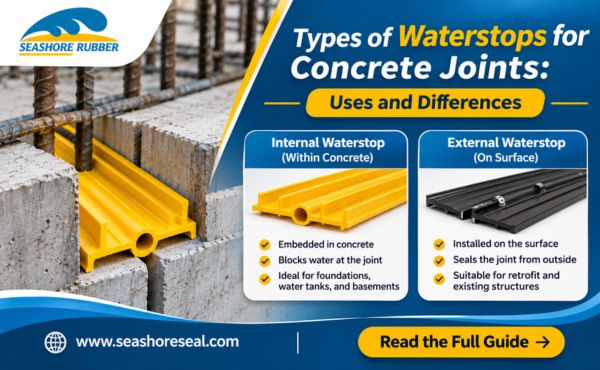
External Waterstops
External waterstops, also called base-seal waterstops in certain configurations, are positioned along the outer face of the concrete joint rather than across its central plane.
They are commonly used for slabs-on-ground and selected buried concrete structures.
Their design can simplify some forming and installation operations.
However, external profiles may have limitations at changes in direction, intersections, and certain movement conditions.
The installation position must match the intended water exposure and structural design.
Waterstops for Construction Joints vs Expansion Joints
One of the most important steps in selecting a concrete waterstop is identifying the type of joint.
Construction joints and expansion joints have different functions and movement requirements.
Construction Joints
Construction joints occur where concrete placement is interrupted and subsequently resumed.
In many reinforced concrete structures, these joints are designed to experience little or no relative movement.
Suitable waterstop options may include:
- Flat ribbed PVC waterstops
- Flat rubber waterstops
- Hydrophilic swelling strips
- Approved metal waterstop systems
The final choice depends on joint geometry, water pressure, accessibility, and the project waterproofing design.
Hydrophilic strips can be particularly useful for certain non-moving construction joints because they can be fixed to the hardened concrete surface before the next pour.
However, adequate concrete cover, confinement, and correct placement remain essential.
Expansion Joints
Expansion joints are designed to accommodate relative movement between adjacent structural sections.
Movement can result from temperature changes, settlement, shrinkage, or structural loading.
Waterstops used in these joints must accommodate the expected changes without losing their sealing function.
Centerbulb PVC and rubber waterstops are common options for movement joints.
Some specialized profiles use tear webs or other flexible geometries to accommodate larger movements.
A waterstop suitable for a non-moving construction joint is not necessarily suitable for an expansion joint.
The selected profile must be evaluated against the expected opening, closing, transverse, and shear movement.
Contraction joints also require separate consideration because some may remain relatively stable while others are designed to accommodate measurable movement.
Choosing the Right Waterstop Type
The correct waterstop should be selected according to structural requirements and service conditions.
Several factors influence the decision.
1. Joint type and movement
Identify whether the joint is a construction, expansion, contraction, or isolation joint.
For moving joints, confirm the expected movement direction and magnitude before selecting a waterstop profile.
2. Hydrostatic pressure
Water pressure affects waterstop design, dimensions, anchorage, and the required quality of installation.
Higher-pressure applications may require larger or specially engineered profiles.
The allowable pressure should be verified using the manufacturer’s product data and the relevant project specifications.
3. Material compatibility
Consider exposure to groundwater, wastewater, chemicals, salts, or other substances.
PVC, rubber, and hydrophilic materials have different chemical resistance characteristics.
Where the concrete structure contains chemicals or aggressive fluids, compatibility testing may be required.
4. Waterstop dimensions
Waterstop width, thickness, centerbulb diameter, and anchoring geometry can affect installation and performance.
These dimensions should be selected according to concrete section thickness, reinforcement layout, movement requirements, and project specifications.
5. Installation conditions
Embedded waterstops must be positioned and supported so that concrete can be properly consolidated around the profile.
Hydrophilic strips require secure positioning and adequate concrete confinement.
Installation accessibility and formwork arrangements may influence the most practical waterstop type.
6. Joint continuity
Waterstop intersections, corners, and changes in direction must remain continuously sealed.
Factory-fabricated intersections may help reduce the risk of poorly formed joints for compatible waterstop systems.
The joining procedure must be appropriate for the selected material.
Common Waterstop Installation Problems
Even a correctly specified waterstop may fail if installation conditions compromise its sealing function.
Several problems deserve particular attention.
Incorrect positioning
If an embedded waterstop moves or folds during concrete placement, its anchorage and sealing performance may be reduced.
Poor concrete consolidation
Voids and honeycombing around a waterstop can create water leakage paths.
Concrete must be properly consolidated without displacing or damaging the waterstop.
Defective joints and splices
Inadequate welding, bonding, or vulcanized connections can interrupt the continuous sealing barrier.
PVC waterstop joints generally require an approved heat-welding procedure. Rubber and other materials require their own compatible joining methods.
Premature hydrophilic swelling
Water-swelling strips exposed to moisture before concrete placement may expand before they are adequately confined.
Installation instructions should be followed to prevent premature activation.
Unsuitable movement capacity
Using a non-moving waterstop profile in an active expansion joint can lead to excessive stress or loss of sealing performance.
These installation risks highlight why waterstop material, profile design, and construction procedures must be considered together.
Conclusion
The main types of waterstops used in concrete joints include PVC, rubber, hydrophilic, and metal waterstops. Each provides a different combination of sealing mechanism, flexibility, installation requirements, and environmental resistance.
PVC waterstops are widely used for general concrete waterproofing. Rubber waterstops provide flexible sealing options for demanding structural applications. Hydrophilic waterstops are particularly useful for suitable non-moving construction joints, while metal waterstops serve more specialized requirements.
The final selection should be based on joint movement, hydrostatic pressure, chemical exposure, concrete geometry, and installation conditions.
Seashore manufactures PVC waterstops, rubber waterstop profiles, and water-swelling rubber strips for concrete waterproofing applications. Contact our team with your project drawings, joint dimensions, and performance requirements to discuss suitable waterstop materials and profiles.


Leave a Reply
Want to join the discussion?Feel free to contribute!