
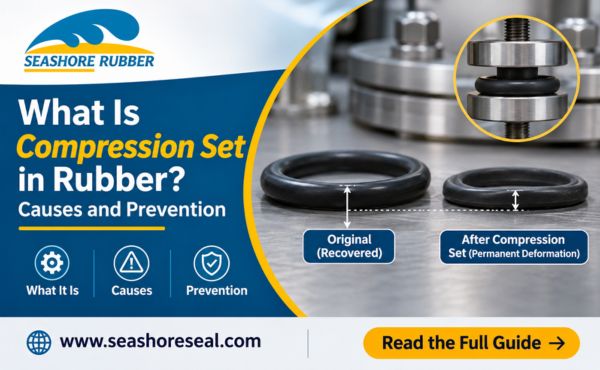
What Is Compression Set in Rubber? Causes and Prevention
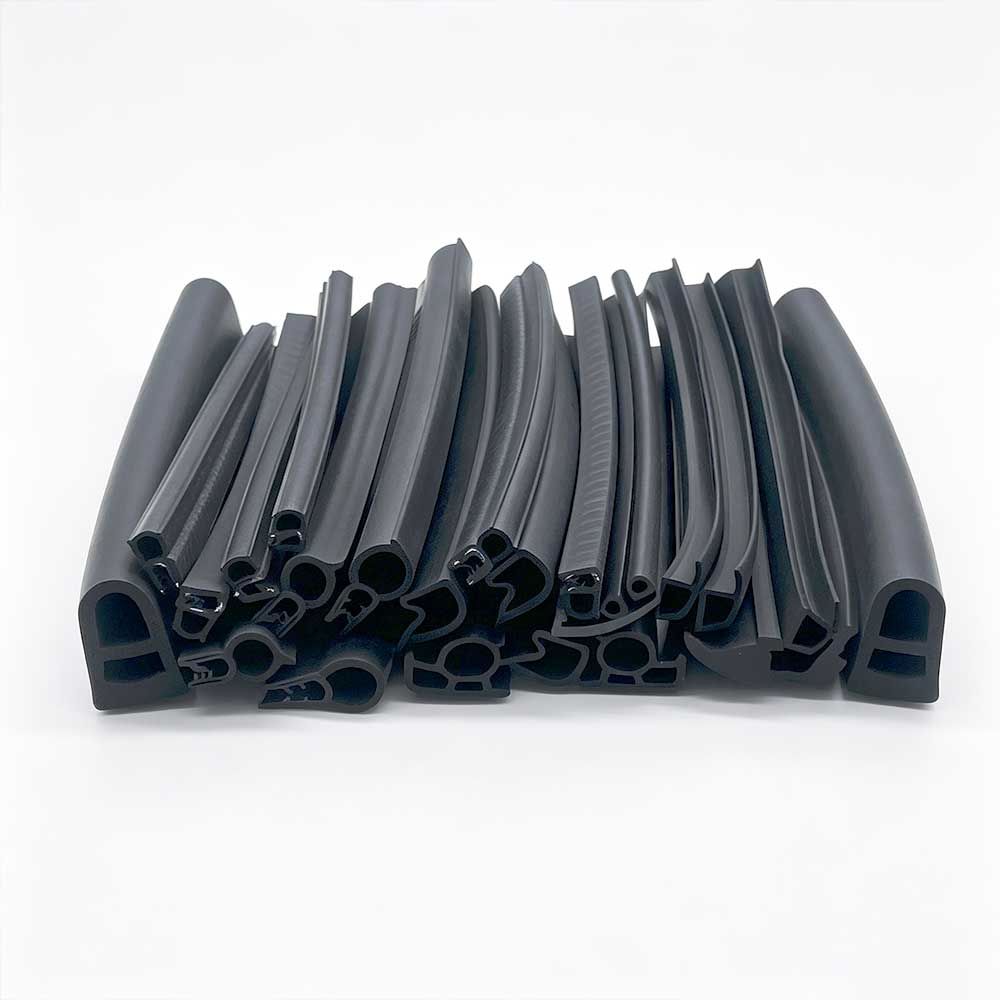
Rubber compression set is the permanent deformation that remains after a rubber material has been compressed for a specified period and the compressive force is removed. It indicates how well the rubber recovers its original thickness after prolonged compression.
Compression set is particularly important for rubber seals, gaskets, and other components that depend on elastic recovery to maintain contact with surrounding surfaces.
A lower compression set generally indicates better recovery after compression. However, the actual sealing performance also depends on contact pressure, material properties, operating temperature, and seal design.
What Is Rubber Compression Set?
Rubber materials are elastic, meaning they can deform under an applied force and recover when that force is removed.
However, rubber does not always return completely to its original dimensions after remaining compressed for an extended period.
Some deformation may remain because the internal polymer structure has undergone physical rearrangement or chemical changes.
This remaining deformation is known as compression set.
A rubber seal with high compression set has lost a greater proportion of its ability to recover its original thickness under the specified test conditions. A seal with low compression set generally retains better dimensional recovery.
Compression set is commonly expressed as a percentage.
It is important to distinguish compression set from normal elastic deformation. Elastic deformation is largely recoverable when the load is removed, while compression set measures the deformation that remains after a defined recovery period.
How Compression Set Affects Rubber Seals
Rubber seals work by maintaining contact with adjacent surfaces. Compression produces the contact pressure needed to resist the passage of air, water, dust, or other media.
Over time, rubber materials can experience permanent deformation and changes in their mechanical properties.
When compression set develops, the seal may no longer recover sufficiently if the sealing gap increases or the mating surfaces move apart.
Potential consequences include:
- Reduced ability to accommodate changes in sealing gaps
- Incomplete recovery after repeated opening and closing
- Greater risk of leakage when contact pressure becomes insufficient
- Reduced sealing reliability during temperature changes
- Permanent flattening of rubber profiles
However, compression set does not directly measure sealing force.
A seal can experience some permanent deformation while continuing to provide an effective seal. Conversely, a material with a relatively low compression set may still fail if its geometry, compression force, or chemical compatibility is unsuitable.
For this reason, compression set should be considered alongside compression stress relaxation, hardness, and seal design.
Common Causes of Compression Set
Compression set develops through a combination of material behavior, operating conditions, and component design.
Prolonged Compression and High Temperatures
Rubber held under compression experiences gradual changes in its internal polymer network.
During prolonged compression, polymer chains and other compound constituents may rearrange. Some of these changes are not fully reversible.
High temperatures can accelerate this process by increasing molecular mobility and promoting chemical aging reactions.
Heat exposure may also lead to changes in crosslinks or degradation of the polymer structure, depending on the compound and surrounding environment.
As a result, a rubber material that recovers well after short-term compression at room temperature may show significantly greater compression set after extended exposure to elevated temperatures.
Both compression duration and temperature must therefore be considered when evaluating long-term performance.
Rubber Formulation and Curing
The composition of a rubber compound has a major influence on its compression recovery.
Different elastomers have different molecular structures and aging characteristics. However, the base polymer is only one factor.
Fillers, plasticizers, processing additives, and curing systems can also influence the final properties.
Vulcanization creates crosslinks between polymer chains, helping the rubber maintain its elastic structure.
An insufficiently cured compound may exhibit poor compression recovery because its polymer network has not developed as intended.
The type and density of crosslinks also influence the balance between flexibility, strength, heat resistance, and compression set.
Therefore, two rubber products made from the same base polymer may produce different compression set results.
Excessive Compression and Poor Seal Design
Compression is necessary for effective sealing, but excessive deformation can create additional problems.
When a seal is compressed beyond its intended operating range, it may experience excessive strain, unwanted deformation, or structural damage.
These problems are especially relevant to sponge rubber seals, where severe compression may damage the cellular structure.
Improper groove dimensions, insufficient clearance, and unsuitable profile geometry can also affect how the material deforms under load.
The correct compression level depends on the rubber material, seal cross-section, hardness, and installation conditions.
A fixed compression percentage should not be applied to every rubber seal without considering these factors.
Chemical Exposure and Material Aging
Rubber materials can swell, soften, harden, or degrade when exposed to incompatible chemicals.
Chemical exposure may alter the polymer network or extract ingredients from the compound, affecting its ability to recover after compression.
Petroleum-based oils, solvents, cleaning agents, and other substances can produce different effects depending on the elastomer.
Environmental aging also contributes to permanent deformation.
Heat, oxygen, ozone, and prolonged environmental exposure can change the rubber’s mechanical properties over time.
Selecting a chemically compatible compound is therefore essential for controlling compression set in demanding applications.
How Rubber Compression Set Is Tested
Compression set testing evaluates the recovery of a rubber specimen after controlled compression under specified conditions.
Two widely recognized standards are ASTM D395 and ISO 815-1.
ASTM D395 includes methods based on constant force and constant deflection. ISO 815-1 specifies compression set methods at ambient or elevated temperatures.
A typical constant-deflection test involves the following procedure:
- Measure the original thickness of the rubber specimen.
- Compress the specimen to a specified thickness using a suitable fixture.
- Maintain compression for a defined period at the specified temperature.
- Release the compression and allow the specimen to recover under controlled conditions.
- Measure the recovered thickness and calculate the compression set percentage.
Testing conditions are important because the resulting value depends on the temperature, compression duration, deformation level, and recovery period.
For this reason, compression set results should always be reported together with the applicable test method and conditions.
A result obtained after 24 hours at one temperature cannot automatically be compared with a result obtained after a much longer period or at a higher temperature.
How to Calculate Compression Set
For a typical constant-deflection compression set test, the result is calculated using the original thickness, compressed thickness, and recovered thickness.
Compression Set (%) = [(T₀ − Tᵣ) / (T₀ − Tₛ)] × 100
Where:
- T₀ = Original specimen thickness
- Tᵣ = Recovered thickness after compression
- Tₛ = Specified compressed thickness
Consider a rubber specimen with an original thickness of 10 mm.
The specimen is compressed to 7.5 mm and held under the specified test conditions. After the compression is released and the recovery period is completed, its thickness is measured at 9.5 mm.
The compression set is:
Compression Set = [(10 − 9.5) / (10 − 7.5)] × 100
Compression Set = 20%
This result means that 20% of the imposed thickness reduction remains after the defined recovery period.
It does not mean the rubber has lost 20% of its original thickness.
The distinction is important when interpreting compression set data and comparing different rubber compounds.
Understanding Compression Set Test Results
Lower compression set values generally indicate that a material recovers more of its original thickness after testing.
However, there is no single compression set percentage that determines whether every rubber material is acceptable for sealing.
Acceptable values depend on the application, material type, test conditions, and required service performance.
Several factors must be considered.
Test temperature
Higher testing temperatures can accelerate changes in rubber properties. Results obtained at different temperatures should not be treated as directly equivalent.
Compression duration
Longer exposure may increase permanent deformation. A short-term laboratory test cannot, by itself, predict the service life of a rubber seal.
Rubber type and formulation
Dense rubber and sponge rubber behave differently during compression. In closed-cell sponge rubber, cell structure and gas movement can affect both deformation and recovery.
Recovery conditions
The measured value depends partly on how long the specimen is allowed to recover and under what conditions.
Sealing force
Compression set measures dimensional recovery rather than the actual contact force maintained by the seal.
Compression stress relaxation describes the reduction in compressive force over time while a rubber component is held at a specified deformation.
Both properties can be important when evaluating long-term sealing performance, but they are not interchangeable.
How to Reduce Compression Set in Rubber
Reducing compression set requires an appropriate combination of rubber formulation, component design, and operating conditions.
Select Rubber Compounds With Suitable Recovery Properties
Different rubber compounds offer different levels of compression recovery and resistance to aging.
EPDM is commonly used for outdoor seals and gaskets because of its excellent resistance to weathering and ozone. Suitable EPDM formulations can also provide good compression set resistance.
Silicone compounds may offer useful compression recovery over demanding temperature ranges, depending on their formulation.
Nitrile rubber is often selected for oil-resistant seals, but its compression set performance must be evaluated against the required operating temperature and exposure conditions.
Material selection should be based on compound-specific test results rather than general assumptions about an elastomer family.
Control Compression During Installation
Proper seal design helps distribute compression and prevents excessive deformation.
Groove dimensions, profile thickness, installation clearances, and manufacturing tolerances should be considered together.
Compression requirements also vary between solid rubber and sponge rubber.
For closed-cell sponge seals, excessive compression can damage the cells and produce permanent changes in thickness.
Where appropriate, mechanical compression stops or controlled mounting dimensions can help prevent excessive deformation.
Minimize Excessive Heat Exposure
Operating temperatures should remain within the verified limits of the selected compound.
Where elevated temperatures are unavoidable, a rubber material with suitable heat-aging and compression recovery properties should be specified.
The duration of exposure is also important. Intermittent temperature peaks and sustained high-temperature operation may affect the material differently.
Prevent Chemical Incompatibility
Rubber exposed to incompatible oils, solvents, or other chemicals may lose mechanical integrity and become more susceptible to permanent deformation.
Before selecting a compound, identify the substances it will contact and evaluate their concentration, temperature, and exposure duration.
Where necessary, chemical immersion and aging tests should be included in material qualification.
Verify Material Quality and Curing
Consistent compound preparation and vulcanization are important for obtaining repeatable compression set performance.
Manufacturing quality control should address the curing process, material consistency, and relevant physical properties.
For applications with demanding sealing requirements, requesting compression set test results under specified conditions provides a more reliable basis for comparing materials than relying on nominal hardness alone.
Conclusion
Rubber compression set measures the dimensional recovery of a rubber material after prolonged compression. It is an important property for seals and gaskets that must maintain effective contact under changing operating conditions.
Compression duration, temperature, compound formulation, curing quality, chemical exposure, and seal design all influence permanent deformation.
Lower compression set generally indicates better recovery, but it does not guarantee effective sealing. Contact pressure, compression stress relaxation, dimensional accuracy, and material compatibility must also be considered.
Seashore manufactures custom rubber extrusion profiles, sponge rubber seals, and industrial sealing components. Contact our team with your application requirements, profile dimensions, and material specifications to discuss suitable rubber sealing solutions.


Leave a Reply
Want to join the discussion?Feel free to contribute!